
Keyless Car Theft: How Relay Attacks Work And How To Protect Your Car
Learn how relay theft works, which everyday precautions help and why testing your key storage matters.
The short answer
Keyless car theft can happen when criminals extend communication between a genuine key and the vehicle, making the car respond as though its key is nearby. You can reduce this risk by blocking the key’s signal, switching off passive entry where your vehicle allows it and adding visible physical security. The important distinction is that no single precaution covers every theft method. Whether your car spends the night on a driveway or the day in a New Forest car park, combine sensible key storage with checks that your protection actually works.
How does keyless car theft through a relay attack work?
A relay attack extends communication between a keyless car and its genuine key, so the vehicle may unlock and authorise starting even though the key is elsewhere. The thief does not need to take the key first. This exploits the car’s proximity-based convenience feature rather than physically copying the key.
Passive keyless entry lets you unlock a vehicle with the key in a pocket or bag, without pressing its remote button. On vehicles with keyless starting, the car also checks for an authorised key before allowing the engine to start.
Not every remote-control key provides passive entry. A key with buttons is not automatically vulnerable to this particular method, and a start button alone does not tell you which entry features are fitted. Check your handbook or the vehicle’s specification.
The practical lesson is straightforward: a locked car and a key safely inside your house are not, by themselves, enough to prevent relay theft. Equally, relay protection does not prevent every other form of vehicle theft.

Everyday key storage makes a difference
Keep your main key and spare away from external doors and windows. A hallway hook is convenient, but it puts the key close to the outside of the property. Choose a less exposed storage position without assuming distance alone will block communication.
Protect every working key, not just the one used daily. A spare left in a kitchen drawer near an outside wall can undermine an otherwise careful routine. Your storage arrangements should also account for any keys held by other household members.
Some vehicles allow passive keyless entry to be disabled through their settings or a manufacturer-specified procedure. Check the handbook for your exact model: turning off passive entry may change how you unlock the car, and available settings vary.
If you change a setting, confirm the result with your own vehicle. Do not rely on advice for a different trim or model year simply because its key looks identical.
Does a Faraday pouch for car keys really work?
A Faraday pouch for car keys can help prevent relay theft by shielding the key from radio communication, provided it blocks the relevant signals and closes properly. It must be tested with your own car. Worn linings, damaged seams or using the wrong pocket can leave the key communicating normally.
Place the key in the shielded compartment and close the pouch fully. With any other working keys well away, approach your locked car and try its normal passive-entry handle. If it unlocks, the pouch is not providing the protection you need in that test.
Some pouches have an ordinary storage pocket alongside the shielded section. Check which one you are using, especially if the key fits easily into either. Retest periodically and after visible wear; successful testing when new does not prove the lining remains effective indefinitely.
A metal tin may also block signals, but the fit of its lid and its construction matter. Test it rather than trusting its appearance. Neither a pouch nor a tin should become a reason to leave keys visible or accessible to someone entering the home.
Physical security adds another obstacle
A steering wheel lock adds a separate physical barrier. It does not stop the key’s signal being relayed, but it means electronic access is not the only obstacle protecting the vehicle. Choose one that fits correctly and use it consistently rather than leaving it in the boot.
Parking arrangements matter too. Where practical, use a locked garage or a secured driveway barrier. In public parking, favour visible, well-lit areas without treating lighting as theft prevention on its own.
After locking, look for the vehicle’s normal confirmation and check it is secure in the way your handbook recommends. With passive entry, pulling the handle while carrying an unshielded key may simply unlock it again, so an apparently unsuccessful check can be misleading.
When considering how to stop keyless car theft, think in layers: signal protection, controlled access to keys and physical security. Each addresses a different weakness.
What happens if a key is lost or stolen?
A missing key creates a different security problem from relay theft because someone may possess a genuinely authorised key. On many cars, lost or stolen keys can be removed from the vehicle’s electronic authorisation memory. Ask what functions are being disabled, because electronic deletion does not change a physical door lock.
If theft is suspected, report it to the police and tell your insurer promptly. Keep any crime reference and explain whether the missing key was taken with information identifying your vehicle or address. Avoid assuming the car is safe simply because it has not moved.
Discuss lost-key replacement and security options, including whether all remaining keys need to be present. A deleted key may no longer authorise starting, but its mechanical blade could still fit the existing lock. Physical lock changes may therefore need consideration.
Requirements vary by model and security system. Owners of newer vehicles can check the Land Rover key information, for example, before assuming that arrangements for an older vehicle also apply to theirs.
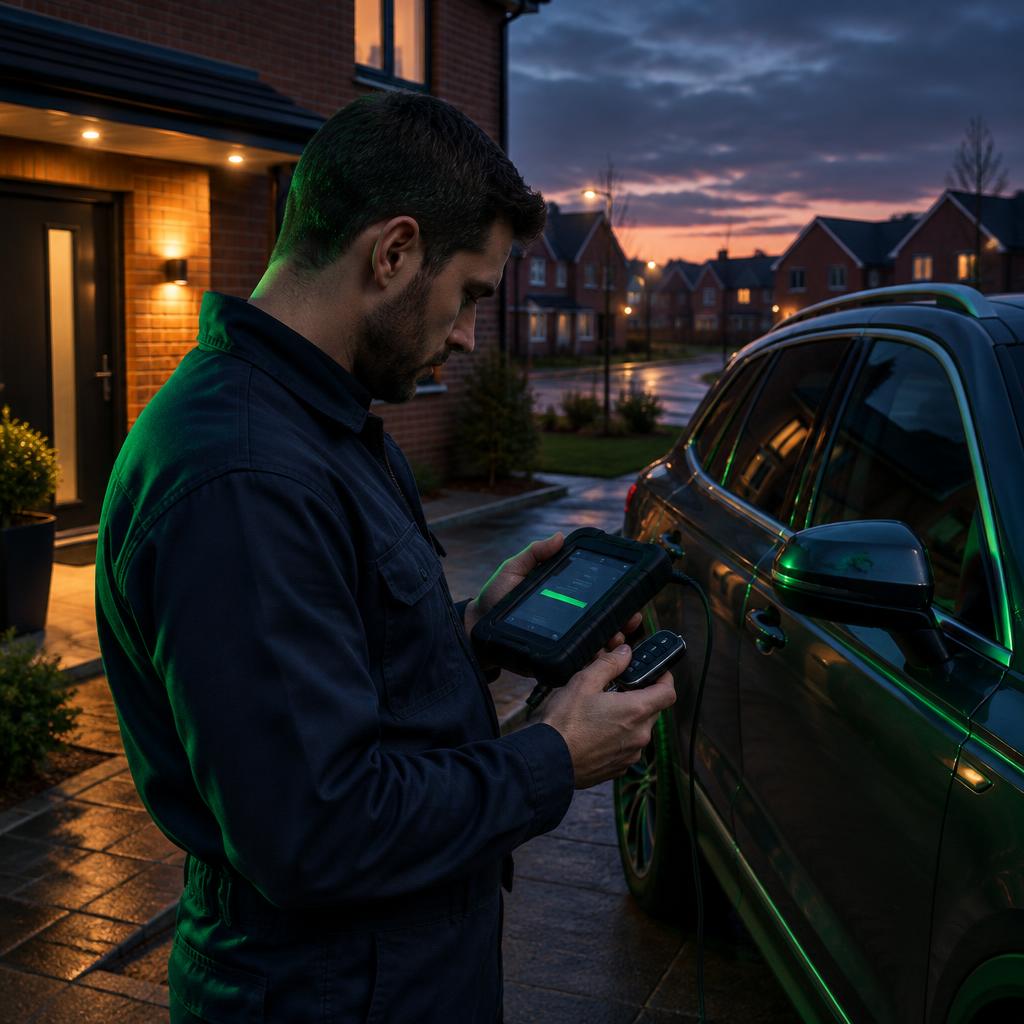
Your practical protection checklist
Build a routine that works at home and while you are out. A pouch left on the kitchen counter cannot protect the key in your coat while you stop for lunch after a New Forest walk.
Confirm whether your vehicle has passive keyless entry.
Store every working key away from outside doors and windows.
Test your signal-blocking storage with other keys out of range.
Check whether the handbook offers a way to disable passive entry.
Fit suitable physical security whenever you leave the vehicle.
If an authorised key goes missing, promptly reassess your vehicle’s security.
Related services
For a missing authorised key, see the lost car keys service to discuss replacement and electronic deletion. New Forest Auto Locksmith makes a new key only after verifying the V5C and photo ID.
More questions
Get a free quote in two quick steps
Send your details and we'll come back to you with a price. For anything urgent, calling is quickest.
- Price explained before any work
- No upfront payment
- Deal direct with the technician
Need a hand with your car key?
If you are unsure what a missing key means for your car’s security, contact New Forest Auto Locksmith with the registration and details of any keys you still have. Advice can then reflect the actual vehicle rather than assumptions based on its badge or appearance.
“The door-open button on the keycard for my 2003 Renault Laguna stopped working on Friday; I had a spare keycard which wasn't working properly either. Both keycards were sorted.”